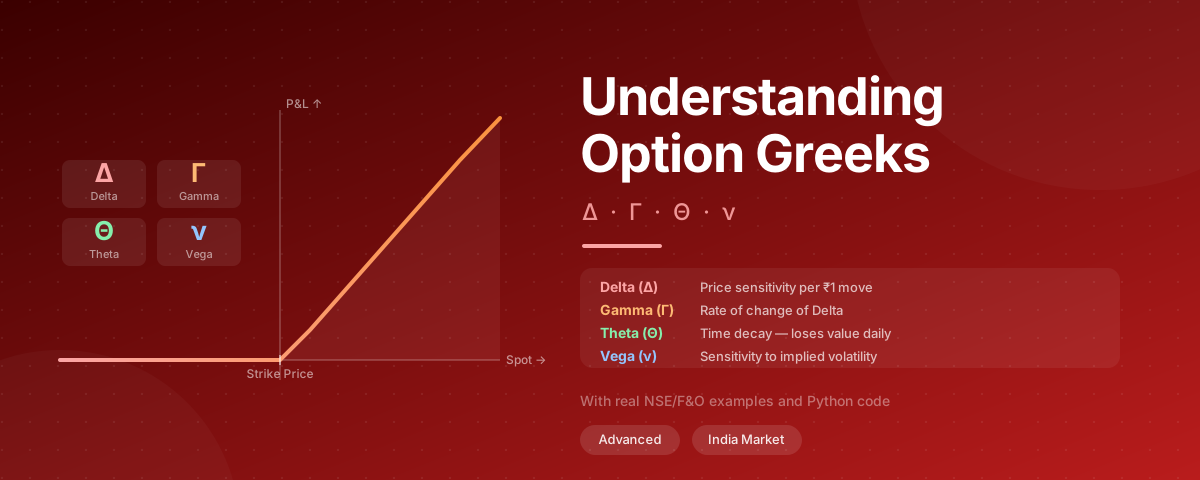
Options are priced based on several factors: the underlying price, strike price, time to expiry, volatility, and interest rates. The "Greeks" quantify the sensitivity of an option's price to each of these factors. Mastering them is the difference between systematic options trading and gambling.
The Four Primary Greeks
| Greek | Measures | Range | Most important for |
|---|---|---|---|
| Delta (Δ) | Price sensitivity to underlying movement | 0 to 1 (calls), -1 to 0 (puts) | Directional traders |
| Gamma (Γ) | Rate of change of Delta | Always positive | Managing Delta exposure |
| Theta (Θ) | Time decay — value lost per day | Always negative for buyers | Option sellers, time management |
| Vega (ν) | Sensitivity to implied volatility change | Always positive | Volatility trading strategies |
Delta: Your Directional Exposure
Delta tells you how much an option's price changes for a ₹1 move in the underlying. A Nifty Call with Delta 0.5 means: if Nifty rises ₹100, the call rises ~₹50.
- ATM (At-the-money) options have Delta ~0.5
- Deep ITM options have Delta near 1.0 (calls) or -1.0 (puts)
- Far OTM options have Delta near 0
- Delta also approximates probability of expiring ITM: 0.5 Delta = ~50% chance
💡 Pro Tip: Delta hedging: If you're short a Nifty Call with Delta 0.6 (1 lot = 50 units), your exposure is 0.6 × 50 = 30 Nifty equivalents. Buy 30 units of Nifty futures to delta-hedge.
Theta: The Option Seller's Ally
Theta is why option sellers love weekly expiries. An option loses value every day simply due to passage of time, even if the underlying doesn't move. This decay accelerates in the last 7–10 days before expiry.
Example: A Nifty 24000 CE (Call) trading at ₹200 with Theta -5 loses ₹5 per day. In 10 days (if market stays flat): option worth ₹150. The seller collects ₹50 of theta.
⚠️ Important: Theta works for sellers but against buyers. Buying options close to expiry is extremely risky — time decay can destroy your premium even if you're directionally right but the move comes too slowly.
Vega: Volatility's Impact on Option Prices
Vega measures how much an option's price changes for a 1% change in implied volatility (IV). Options are expensive when IV is high and cheap when IV is low.
- India VIX above 20: options are expensive (high IV) — better to sell options
- India VIX below 14: options are cheap (low IV) — better to buy options
- Long Straddle/Strangle: benefits from rising Vega (buy before earnings/RBI)
- Short Strangle: benefits from falling Vega (sell after event-driven IV spike)
Gamma: The Acceleration of Delta
Gamma tells you how quickly Delta changes. ATM options have the highest Gamma — this is why being short ATM options close to expiry is dangerous (called "Gamma Risk" or "Pin Risk").
Example: Nifty is at 24,000. You're short a 24000 CE with Delta 0.5 and Gamma 0.02. If Nifty moves to 24,100 (+100 points): new Delta = 0.5 + (0.02 × 100) = 0.7. You're now much more exposed than before.
Practical NSE Example: Selling a Strangle
Strategy: Sell 1 lot Nifty 24500 CE + Sell 1 lot Nifty 23500 PE (weekly expiry, Nifty at 24,000)
- Premium collected: ₹80 (CE) + ₹70 (PE) = ₹150 × 50 = ₹7,500 per strangle
- Delta: short 0.25 delta (call) + short -0.25 delta (put) = near delta-neutral
- Theta: collecting ~₹15–20 per day in time decay
- Risk: Nifty breaks 24,500 or 23,500 before expiry — losses can exceed premium
Key Takeaways
- Always check all four Greeks before entering an options position
- Theta is your friend as a seller — sell with sufficient time premium
- Monitor Vega: Don't buy options when IV is high (you overpay)
- Gamma risk spikes near expiry and near ATM strikes — manage accordingly
- Delta tells you your current directional exposure at any moment